The Levantine Arabic Speech Dataset is a meticulously curated collection of high-quality audio recordings from native Levantine Arabic speakers across Syria, Lebanon, Jordan, and Palestine. This comprehensive linguistic resource features 100 hours of authentic Levantine Arabic speech data professionally annotated and structured for advanced machine learning applications.
Levantine Arabic, spoken by over 40 million people in Eastern Mediterranean region, is captured with distinctive phonological features characteristic of this major Arabic dialect crucial for regional speech recognition technologies.
Dataset General Info
| Parameter | Details |
|---|---|
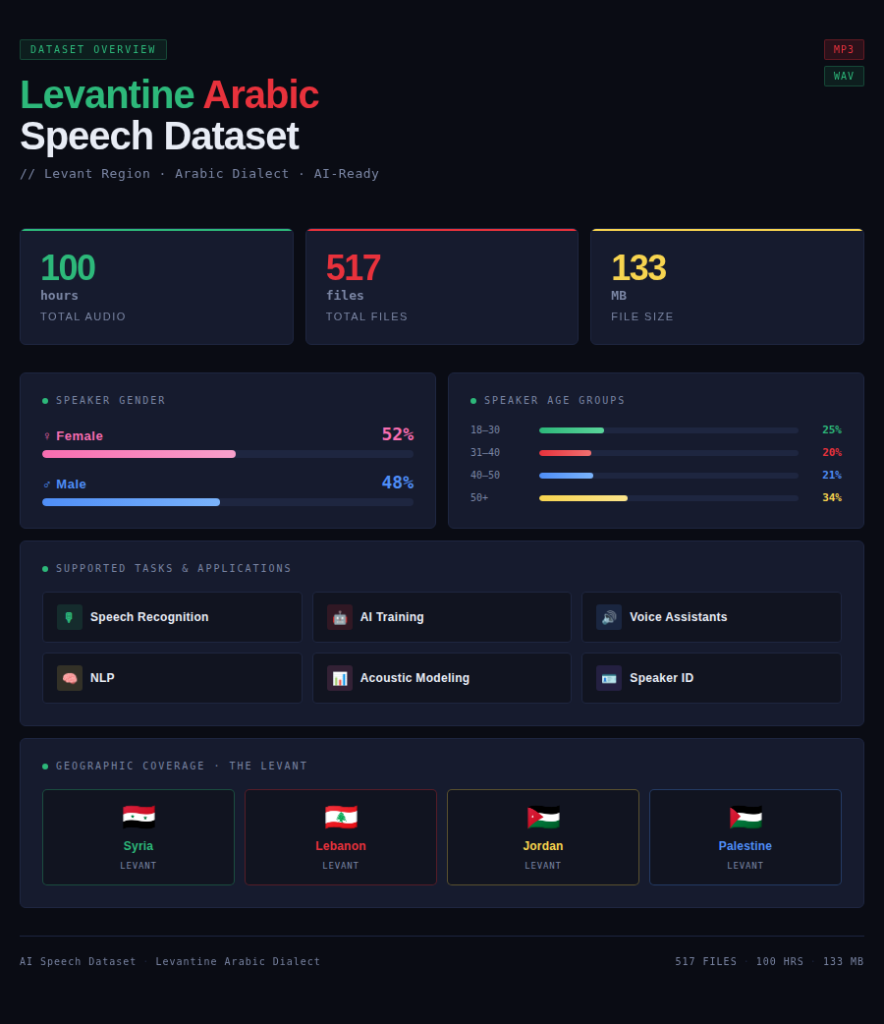
| Size | 100 hours |
| Format | MP3/WAV |
| Tasks | Speech recognition, AI training, voice assistant development, natural language processing, acoustic modeling, speaker identification |
| File size | 133 MB |
| Number of files | 517 files |
| Gender of speakers | Female: 52%, Male: 48% |
| Age of speakers | 18-30 years: 25%, 31-40 years: 20%, 40-50 years: 21%, 50+ years: 34% |
| Countries | Syria, Lebanon, Jordan, Palestine |
Use Cases
Regional Communication and Integration
Organizations working across Syria, Lebanon, Jordan, and Palestine can utilize the Levantine Arabic Speech Dataset to develop regional platforms, cross-border communication tools, and Levantine integration systems. Voice interfaces in Levantine Arabic dialect support regional identity, facilitate commerce and cultural exchange across Eastern Mediterranean, strengthen linguistic connections among Levantine populations, and enable services transcending modern borders. Applications include regional e-commerce, cultural exchange platforms, diaspora communication, and information systems serving shared Levantine identity.
Diaspora and Refugee Services
Organizations serving Levantine diaspora and refugee populations globally can leverage this dataset to build communication tools, resettlement assistance platforms, and cultural connection services. Voice technology helps displaced Levantine populations maintain linguistic and cultural identity, supports refugee services in camps and host countries, enables access to information and assistance, and facilitates family connections across distances. Applications include refugee information hotlines, resettlement assistance, language maintenance tools, remittance platforms, and services supporting millions displaced by regional conflicts.
Media and Content Production
Levantine media companies can employ this dataset to develop automatic transcription for Arabic dialect broadcasting, content production tools, and voice-enabled media platforms. Voice technology supports vibrant Levantine entertainment industry including Syrian and Lebanese television, music, and digital content, enables dialect-specific content production, facilitates media accessibility, and strengthens Levantine Arabic presence in Arabic-language media landscape competing with Egyptian and Gulf varieties.
FAQ
Q: What is included in this dataset?
A: The dataset includes 100 hours of audio recordings with 517 files totaling 133 MB, complete with transcriptions and linguistic annotations.
Q: How diverse is the speaker demographic?
A: Features 52% female and 48% male speakers across age groups: 25% (18-30), 20% (31-40), 21% (40-50), 34% (50+).
How to Use the Speech Dataset
Step 1: Dataset Acquisition – Download the dataset package from the provided link upon purchase.
Step 2: Extract and Organize – Extract to your storage and review the structured folder organization.
Step 3: Environment Setup – Install ML framework dependencies and audio processing libraries.
Step 4: Data Preprocessing – Load audio files and apply preprocessing steps like resampling and feature extraction.
Step 5: Model Training – Split into training/validation/test sets and train your model.
Step 6: Evaluation and Fine-tuning – Evaluate performance and iterate on architecture.
Step 7: Deployment – Export and integrate your trained model into production systems.
For comprehensive documentation, refer to included guides.